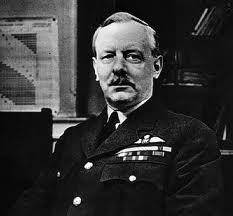
Sir Arthur ‘Bomber’ Harris, (1892-1984)
MARSHAL of the Royal Air Force Sir Arthur Travers Harris, 1st Baronet GCB OBE AFC
Known as “Bomber” Harris by the press, and often within the RAF as “Butcher” Harris, was Air Officer Commanding-in-Chief (AOC-in-C) of RAF Bomber Command (from early 1943 holding the rank of Air Chief Marshal)[ during the latter half of the Second World War.
During the early part he was in charge at St Vincent’s, Grantham, while living at Norman Leas, Beacon Lane.
In 1942 the Cabinet agreed to the area bombing of German cities. Harris was tasked with implementing Churchill’s policy and supported the development of tactics and technology to perform the task more effectively.
Harris’ preference for area bombing over precision targeting in the last year of the war remains controversial, partly because by this time many senior Allied air commanders thought it less effective and partly for the large number of civilian casualties and destruction this strategy caused in Continental Europe.
Harris was born at Cheltenham, where his parents were staying while his father was on home leave from the Indian Civil Service.
He was educated at Allhallows School in Devon, while his brothers were educated at Sherborne and Eton.
At the age of 16, not considered academically gifted by his parents, he was given the choice of “either army or the colonies.”
He went to Rhodesia (now Zimbabwe and Zambia) in 1908, where over the next few years he flourished earning his living “gold mining, driving coaches and general farming”
At the outbreak of the First World War, Harris joined the 1st Rhodesian Regiment as a bugler, and served with them in South Africa and in the German colony of South-West Africa (now Namibia).
The following year he returned to England and joined the Royal Flying Corps, serving with distinction on the home front and in France during 1917 as a flight commander and ultimately CO of No. 45 Squadron, flying the Sopwith 1½ Strutter and Sopwith Camel.
Harris claimed five enemy aircraft destroyed and was awarded the Air Force Cross (AFC). He finished the war a major.
After the war, Harris remained in the newly-formed Royal Air Force.
In April 1920 Squadron Leader Harris was jointly appointed station commander of RAF Digby and commander of No. 3 Flying Training School. He later served in different functions in India, Mesopotamia (now Iraq and Syria), and Persia (now Iran).
In 1924 Harris was posted to England to command the first post-war heavy bomber squadron (No. 58).
His next command was of a flying-boat squadron, where he continued to develop night flying techniques. From 1934 to 1937 he was the Deputy Director of Plans in the Air Ministry.
In 1937 he was promoted to Air Commodore and in 1938 he was put in command of No. 4 (Bomber) Group and in September 1939 took command of No. 5 Group. In November 1940 he was made Deputy Chief of the Air Staff and then in 1941 he was promoted to Air Marshal before being appointed Commander-in-Chief (C-in-C) of Bomber Command in February 1942.
Harris immediately set about rectifying deficiencies with great energy having studied new theories of offensive bombing developed by Germany in Spain and in the early years of World War II.
Harris launched the first RAF “thousand bomber raid” against Cologne (Köln) on the night of 30 May/31 May 1942.
The most controversial raid of the war took place in the late evening of 13 February 1945. The bombing of Dresden by the RAF and USAAF resulting in a lethal firestorm which killed several tens of thousands of civilians.
Harris was made Marshal of the Royal Air Force in 1946.
Harris moved to South Africa in 1948 and was the manager of the South African Marine Corporation (Safmarine), from 1946 to 1953.
In 1953 Harris returned to the UK and lived his remaining years in Goring-on-Thames, in The Ferry House.
There is a statue of Harris outside the RAF Chapel, St. Clement Danes
He died in 1984, eight days before his 92nd birthday, at his home in Goring.

Leave a Reply
You must be logged in to post a comment.