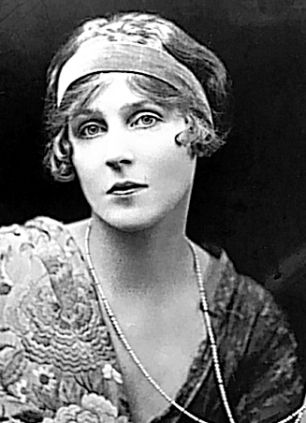
Lady Diana Cooper (1892-1986)
DIANA Cooper, Viscountess Norwich, was a prominent social figure in London and Paris, widely acknowledged as the beauty of the century.
Born Lady Diana Olivia Winifred Maud Manners, at Belvoir Castle, she was officially the youngest daughter of the 8th Duke of Rutland and his wife, the former Violet Lindsay, an artist and onetime member of Queen Victoria’s court. But Lady Diana’s real father was heir to the Brownlow title and Belton Park estate, Harry Cust.
As early as 1908, various pamphlets were being circulated by a former governess claiming that Cust fathered Diana Manners, and Lord Crawford (a distant cousin of her mother) noted in his diary that the resemblance was striking.
In her younger days, she moved in a celebrated group of intellectuals, most of whom were killed in the First World War.
She married one of the only survivors, Duff Cooper, later Ambassador to France. After his death, she wrote three volumes of memoirs which reveal much about 20th-century upper-class life.
In her prime, she had the widespread reputation as the most beautiful young woman in England, and appeared in countless profiles, photographs and articles in newspapers and magazines.
She became active in The Coterie, an influential group of young English aristocrats and intellectuals of the 1910s whose prominence and numbers were cut short by the First World War. Some see them as people ahead of their time, precursors of the Jazz Age.
Lady Diana was the most famous of the group, which included Raymond Asquith (son of H. H. Asquith, the Prime Minister), Patrick Shaw-Stewart, Edward Horner, Sir Denis Anson and Duff Cooper.
Following the deaths at relatively young ages of Asquith, Horner, Shaw-Stewart, and Anson—the first three in the war; Anson by drowning—Lady Diana married Cooper, one of her circle of friends’ last surviving male members, in June 1919.
It was not a popular choice in the Manners household, since the bride’s parents had hoped for a marriage to the Prince of Wales.
She was a friend of royalty and a member of the social set centered on the Prince of Wales, to whom she was close. In fact, she was sailing the Adriatic with him and Wallis Warfield Simpson when word of their romance roiled the nation back home.
Other acquaintances ran the gamut from the theater to Sir Winston and Lady Churchill to Evelyn Waugh. Chaliapin sang and Arthur Rubinstein played the piano at her parties
As for Cooper, he once impulsively wrote a letter to Lady Diana, before their marriage, declaring, “I hope everyone you like better than me will die very soon.”
In 1929 she gave birth to her only child, John Julius Norwich, who became a writer and broadcaster.
After working as a nurse during the war and working as editor of the magazine Femina, she wrote a column in the Beaverbrook newspapers before turning to the stage, playing the Madonna in the revival of The Miracle (directed by Max Reinhardt). The play achieved outstanding international success, and she toured for two years with the cast. Lady Diana subsequently starred in several silent films, including the first British colour films.
In 1924, Duff Cooper was elected to Parliament, while his wife continued as a society celebrity. Her reputation became even more celebrated in France as the centerpoint of immediate post Second World War French literary culture when her husband served from 1944 to 1948 as Britain’s ambassador to France.
During this period, Lady Diana’s popularity as a hostess remained undimmed, even after allegations that the embassy guest list included “pederasts and collaborators”.
Following Duff Cooper’s retirement in 1947, they continued to live in France at Chantilly, until his death in 1954. He was created Viscount Norwich in 1952, for services to the nation, but Lady Diana refused to be called Viscountess Norwich, claiming that it sounded like “porridge”.
Following her husband’s death, she made an official announcement in The Times stating that she wished to be known as Lady Diana Cooper.
Lady Diana sharply reduced her activities in the late 1950s but did produce three volumes of memoirs: The Rainbow Comes and Goes, The Light of Common Day, and Trumpets from the Steep.
Several writers used her as inspiration for their novels, including Evelyn Waugh, who fictionalised her as Mrs Stitch in the Sword of Honour trilogy and elsewhere, and Nancy Mitford, who portrayed her as the narcissistic, self-dramatizing Lady Leone in Don’t Tell Alfred.
In F. Scott Fitzgerald’s short story “The Jelly-bean”, the character Nancy Lamar states that she wants to be like Lady Diana Manners.
Enid Bagnold published The Loved and Envied in 1951. The novel, based on Lady Diana and her group of friends, dealt with the effects of ageing on a beautiful woman.
She appeared in the films The Glorious Adventure (1922) and The Virgin Queen (1923)

Leave a Reply
You must be logged in to post a comment.