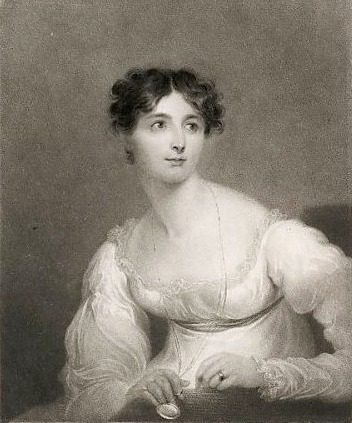
Harriet Arbuthnot (1793-1834)
Harriet Arbuthnot was an early 19th-century English diarist, social observer and political hostess on behalf of the Tory party.
During the 1820s she was the closest woman friend of the hero of Waterloo and British Prime Minister, the 1st Duke of Wellington
She maintained a long correspondence and association with the Duke, all of which she recorded in her diaries, which are consequently extensively used in all authoritative biographies of the Duke of Wellington.
Born into the periphery of the British aristocracy, at Fulbeck Manor, her parents were Henry Fane and his wife, Elizabeth, née Swymmer.
Her observations and memories of life within the British establishment are not confined to individuals but document politics, great events and daily life with an equal attention to detail, providing historians with a clear picture of the events described. Her diaries were themselves finally published in 1950 as The Journal of Mrs Arbuthnot.
The young Harriet spent much of her childhood at the family home at Fulbeck Hall, sited high on the limestone hills.
Harriet married Rt Hon Charles Arbuthnot, member of Parliament, at Fulbeck in 1814. Born in 1767, her husband was 26 years older than she was, an age difference which had initially caused her family to object to the marriage.
Another of the principal obstacles to finalising the arrangements for the marriage was financial. Her widowed mother delegated the arrangements for the marriage of her 20-year-old daughter to her elder son Vere, a 46-year-old widower who was considered qualified in these matters as he worked at Child’s Bank.
It seems that Vere Fane and his mother were not initially prepared to settle enough money on his sister to satisfy her future husband, causing the prospective bridegroom to write to his fiancée: “How can you and I live upon £1000 or £1200 and Fane [her mother] finds it so impossible to live upon her £6000 that she can offer you no assistance whatsoever?”
Charles Arbuthnot was a widower with four children; his son Charles was a mere nine years junior to his new wife. His first wife Marcia, a lady in waiting to the notorious Princess of Wales, had died in 1806. Like the other two men his second wife so admired, Viscount Castlereagh and Wellington,
Marriage to Charles Arbuthnot opened all doors to his young new wife, .
Throughout her marriage, Harriet formed close friendships with powerful older men. She described Castlereagh as her “dearest and best friend” until his death in 1822, when she transferred her affections to the other great 19th-century Anglo-Irish peer, the Duke of Wellington.
All social commentators of the time, however, agree that her marriage was happy; indeed, her husband was as close a friend of Wellington’s as was his wife. Married to a politician, she was fascinated by politics and enjoyed success as a political hostess while exerting her energies to promote Tory causes.
During the early part of her marriage, her husband served as an Under-Secretary at the Treasury. Later, in 1823, he was given the Department of Woods and Forests, a position which gave him charge of the Royal parks and gardens. The subsequent access to the Royal family this allowed increased not only his status but also that of his wife.
When remarking in her diaries on other women who shared their affections with great men of the day, Arbuthnot displayed a sharp, ironic wit. Of Wellington’s one-time mistress Princess Dorothea Lieven, wife to the Imperial Russian ambassador to London from 1812 to 1834, she wrote “It is curious that the loves and intrigues of a femme galante should have such influence over the affairs of Europe.”
Her political observations are clearly written from her own Tory viewpoint. However, her detailed description of the rivalry for power between the Tories and Liberals which took place between 1822 and 1830 is one of the most authoritative accounts of this struggle.
It is likely that Arbuthnot first came to the attention of Wellington during 1814 in the re-opened salons of Paris following the exile of Napoleon to Elba. Wellington had been appointed the British Ambassador to the Court of the Tuileries, and the city was crowded with English visitors anxious to travel on the continent and socialise after the Napoleonic Wars.
Among those sampling the rounds of entertainment in this lively environment were the newly married Arbuthnots. Charles Arbuthnot was known to Wellington, as he had been a strong supporter of Wellington’s younger brother Henry during his divorce, and it is possible Wellington had met, or at least heard of, Mrs Arbuthnot—she was a first cousin to his favourites the Burghersh family.
However, it was only after the death of Castlereagh in 1822 that the Wellington–Arbuthnot friendship blossomed
It has been said that the unhappily married Duke enjoyed his relationship with Mrs Arbuthnot because he found in her company “the comfort and happiness his wife could not give him.” Arbuthnot was certainly the Duke’s confidante in all matters, especially that of his marriage. He confided to her that he only married his wife because “they asked me to do it” and that he was “not the least in love with her.”
As a consequence of his unsatisfactory marriage, Wellington formed relationships with other women, but it was for Arbuthnot that “he reserved his deepest affection.”
Her husband at this time was working at The Treasury and Arbuthnot in effect became what would today be termed Wellington’s social secretary during his first term of premiership between January 1828 and November 1830.[22] It has been suggested that the Duke of Wellington allowed her “almost unrestricted access to the secrets of the cabinet”
Harriet died suddenly of cholera on 2 August 1834 at Woodford Lodge, her home near the Arbuthnots’ seat, Woodford House, Northamptonshire.
Immediately after her death an express message was sent to Apsley House. The messenger, however, had to divert to Hatfield House where Wellington was dining with the Marquess and Marchioness of Salisbury. After her death, it was revealed she had been on a civil list pension of £936 per annum (£85,000 per year as of 2020) since January 1823.
The exact nature of Arbuthnot’s relationship with Wellington has always been a subject for conjecture.
Harriet Arbuthnot was buried in the Fane family plot at St Nicholas’ parish church, Fulbeck

Leave a Reply
You must be logged in to post a comment.