
WELBY Street has gone by three names. It began as Sand Pit Lane, then became Blue Man Street, before settling on the name we know today.
Blue Man Street most likely took its name from the Blue Man, a pub on the corner with Westgate. The building dates from the early 1700s, was first recorded as the Blue Man in 1805 and is now Grade II listed. The “Blue” is likely a nod to the Manners family, who bought up a number of Grantham’s inns around that time and added the colour to their names to show their support for the Whigs. It later became the Malt Shovel and has been several other things since, but it’s now back as a pub called the Blue Man.

Its present name comes from the Welby family of Denton, major landowners in the area. The first four Welby baronets all sat as MP for Grantham at some point between 1802 and 1868.
Welby Street also has a small place in the story of Grantham’s Methodists. Before their first chapel opened on Finkin Street in 1803, they met in a loft above a smithy here, reached by a ladder that could be pulled away. The farrier below had no time for them, and made sure his bellows and hammer were at their busiest whenever a meeting was on.
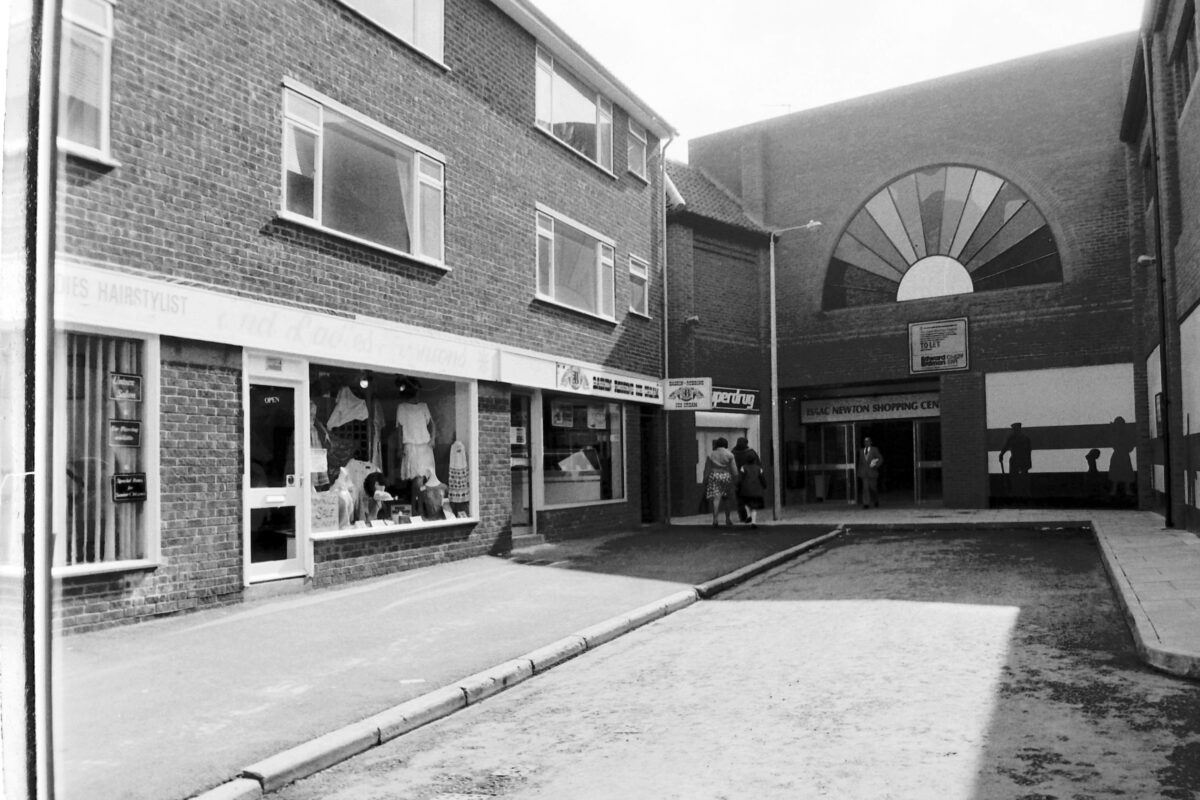
Most of the southern end of the street was flattened in the early 1980s to make way for the Isaac Newton Centre.

WELBY Street Infants opened in 1858, one of the town’s three National Society (Church of England) infant schools, alongside Brownlow and Little Gonerby. It was a two-storey building of patterned, multi-coloured brick under a steep slate roof, with stone corners and window surrounds.
Its pupils came from the poorer parts of town, and it never attracted the kind of funding other schools could count on.

With German bombers taking an interest in Grantham, a town centre school was a risk, and it closed in 1940 for the duration of the war. Numbers had already fallen so far that the running costs were hard to justify, and it never reopened. The building was used for storage until 1983, when it was demolished to make way for the Isaac Newton Centre.

THE Welby Arms was closed down as redundant in 1932, and the figures explain why. Chief Constable John Casburn pointed out there were 25 on-licences (premises licensed to serve drink on the spot) within 200 metres of it, including the Plough, the Peacock and the Durham Ox on Welby Street itself. At the time, the area had one pub for every 86 residents.


Leave a Reply
You must be logged in to post a comment.